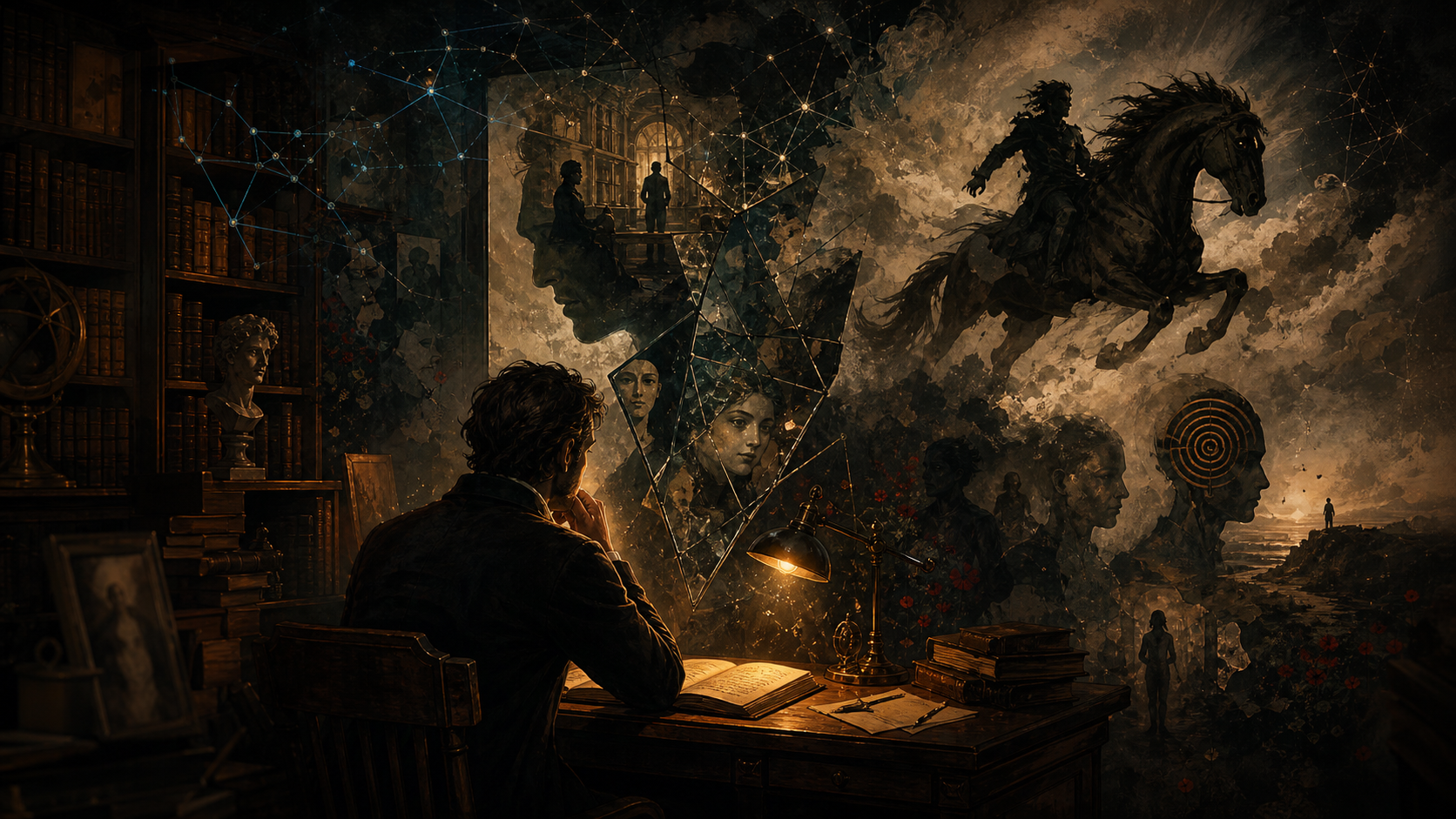
A recent event led me down the rabbit hole of investigating the whole idea of human consciousness.
Questions around whether someone has conscious control over one's actions or not. My research led me through various scientific areas, from Freudian and Jungian theories in the study of the unconscious mind and personality, and the philosophical debate on free will, to Ben Libet's experiment, Daniel Kahneman's System 1 and 2 thinking, and theories of common fallacies and biases.
It was most fascinating to learn of Freud's tripartite mental model of the ID, Superego and Ego, drawing the analogy of the rider with the reins and the wild, animalistic horse. And Jung's theory of the collective unconscious and archetypes which are so evident in modern-day movie scripts that often depict a protagonist playing out the hero, protector, trickster, and how the human mind keeps being drawn to such characters which appeal to our own collective unconscious.
Drilling further into the fields of DID and treatments for it, how modern science draws from older days' teachings which still remain relevant till date, forming the basis of modern-day research and discourse.
Our everyday behaviours are often guided by our unconscious mind, even when we believe we are acting from conscious control.
Ultimately, I've come to learn that our everyday behaviours are often guided by our unconscious mind, although we may be consciously reminding ourselves to do something or just doing something out of muscle memory. Our mind is a complex mechanism that works in parts, tandem, connected and dependent.
In meeting people, our dominant archetypes from the collective unconscious may be evident and in some other social settings, other archetypes take over. All these form the individual makeup. The importance of seeking balance and harmony amongst them forms the basis of a healthy mental state.
Our ego is guided by our superego which has been moulded since childhood and life experiences, and not forgetting the repressed state of the ID. While it's important to have control as a rider to steer, sometimes it is equally important to allow a safe space for the wild horse to roam a little.
Finally, in relation to our conscious and unconscious state of mind, System 1 thinking very often causes us to jump to conclusions, it takes effort to trigger System 2 thinking and the ability to question everything we see.